
Bottle Cap Neck Sizes Explained: 24mm, 28mm, 38mm — and How to Choose



The neck finish is the first spec to lock in. Get it wrong and no cap — regardless of style, color, or material — will fit. Here’s how to read the numbers, measure correctly, and match your bottle to the right closure.
Key Takeaways
- The neck size number (e.g. 28mm) refers to the outer diameter of the bottle’s neck, not the inner opening.
- Thread finish (e.g. 28-410) determines actual compatibility. Two “28mm” caps can be incompatible if thread types differ.
- Standard sizes (24mm, 28mm, 38mm) offer the widest cap selection and fastest lead times. Non-standard sizes require custom tooling.
- Always confirm neck finish with your bottle supplier before ordering cap samples.
Why Neck Size Is the First Decision — Not the Last
Choosing a closure for a new product usually starts with aesthetics: color, finish, whether to go with a flip top or a disc top, matte or glossy. But the spec that actually determines whether a cap physically fits your bottle is one that often gets left until the end — and that’s where costly mistakes happen.
A mismatched neck size means a wasted sampling round, a revised brief, and a delayed launch. Worse, some mismatches aren’t caught until you receive a full production run that won’t seat on your bottle. The fix is simple: nail the neck finish first, then decide everything else.
This guide covers what neck size actually means, how to read a full closure specification, the most common sizes and what they’re used for, how to identify your existing bottle’s size, and how that size constrains your cap options downstream.
What Does “Neck Size” Actually Mean?
The number you see in a cap specification — 28mm, 38mm, 24mm — is the outer diameter of the bottle neck’s thread area, measured in millimeters. It does not refer to the inner opening (the bore), which is smaller and varies by bottle design.
But the diameter alone is not enough to guarantee a cap will fit. The full specification also includes the thread finish — a number that describes the thread pitch, depth, and number of starts. Together, they form a code like 28-410, where:
- 28 — the outer diameter of the neck, in millimeters
- 410 — the GPI thread finish code, describing the thread type and pitch
Two bottles can both be listed as “28mm” but have completely different thread finishes — a 28-410 cap will not fit a 28-400 bottle. This is one of the most common sourcing mistakes US buyers encounter when working with new suppliers. Always confirm the full finish specification, not just the diameter.
GPI vs. PCO Thread Standards
Most consumer product packaging uses GPI (Glass Packaging Institute) thread standards, which cover the vast majority of personal care, food, household, and pharmaceutical bottles. If your spec sheet lists a finish like 24-410, 28-415, or 38-400, you’re working with GPI.
PCO (Plastic Closure Only) is a different standard used almost exclusively for carbonated beverage and water bottles — think PET soda bottles. Unless you’re in the beverage space, you’re almost certainly working with GPI finishes. When in doubt, ask your bottle supplier which standard your neck was designed to.
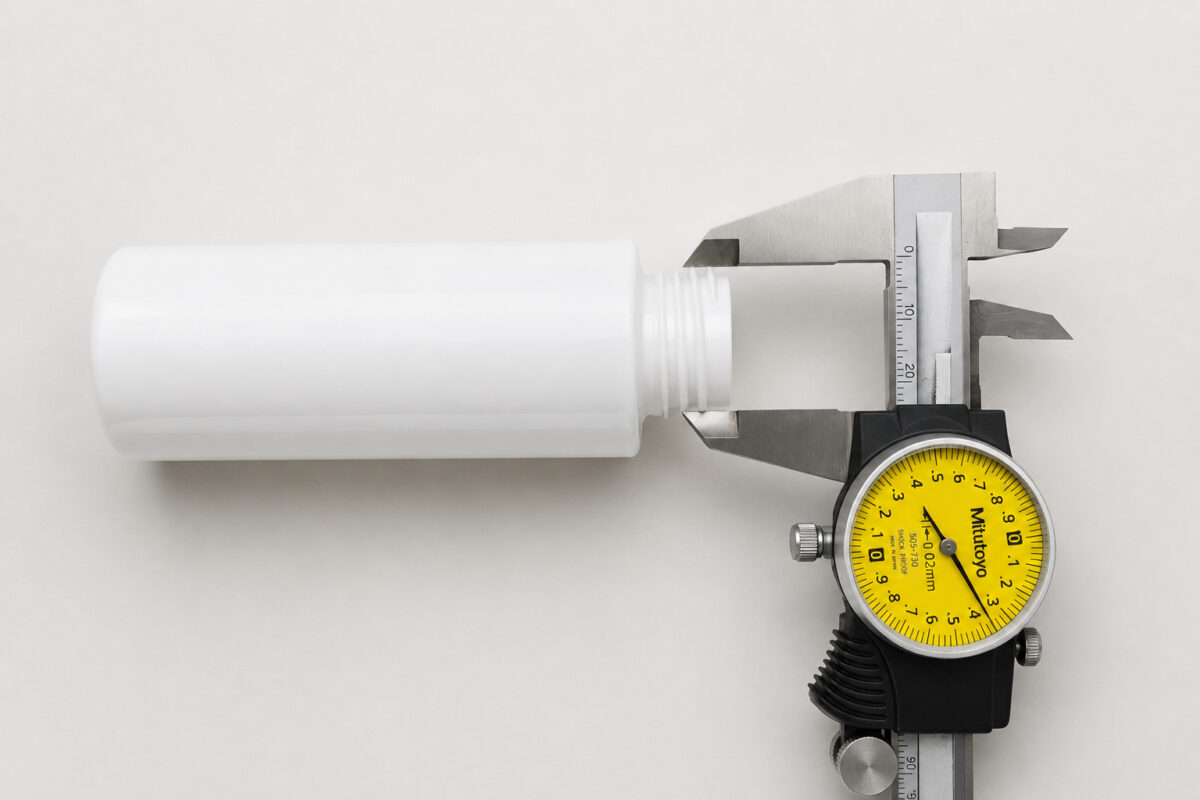
Measuring the outer diameter of the thread with calipers. Measure at the widest point of the threaded section, not the inner bore and not the bottle shoulder.
The Most Common Neck Sizes — and What They’re Used For
While bottles exist in dozens of neck sizes, the packaging industry has largely converged on a handful of standard diameters. Working within these ranges means more off-the-shelf cap options, faster sample lead times, and lower minimum order quantities — because cap tooling already exists.
Small format — dropper, vial, and sample bottles
Used for high-value, low-volume applications where precise dispensing matters. Orifice sizes are intentionally small to control flow. Common cap types include dropper assemblies, snap-on caps, and roll-on applicators.
Medium-small — travel size and specialty format
A popular size for travel-size toiletries and facial care bottles. Accommodates a range of cap styles including flip tops, disc tops, and lotion pumps. Often seen in sleek, narrow bottle profiles where a smaller cap-to-bottle ratio is part of the design brief.
The universal standard — the most widely stocked size
The 28mm finish is the single most common neck size across consumer packaging. It balances a wide cap selection with practical bottle sizing for mid-viscosity liquids. If you’re choosing a neck size for a new product without constraints, 28mm is usually the lowest-risk starting point — cap variety is greatest here, and lead times are shortest.
Wide mouth — thick formulas and squeeze applications
The wider orifice makes 38mm ideal for thicker formulas that would struggle to flow through a smaller opening — body butters, face masks, and heavy conditioners. Wide-mouth squeeze bottles for condiments also commonly use this finish. Cap options include wide-format flip tops, disc tops, and cosmetic jars with inner covers.
Large format — professional and bulk dispensing
Primarily used for large-format containers — bulk lotion pumps, gallon jugs, and professional-grade cleaning products. Cap options narrow at this range, and custom tooling is more common. If you’re sourcing at this size, plan for longer lead times and a direct conversation with your supplier about mold availability.
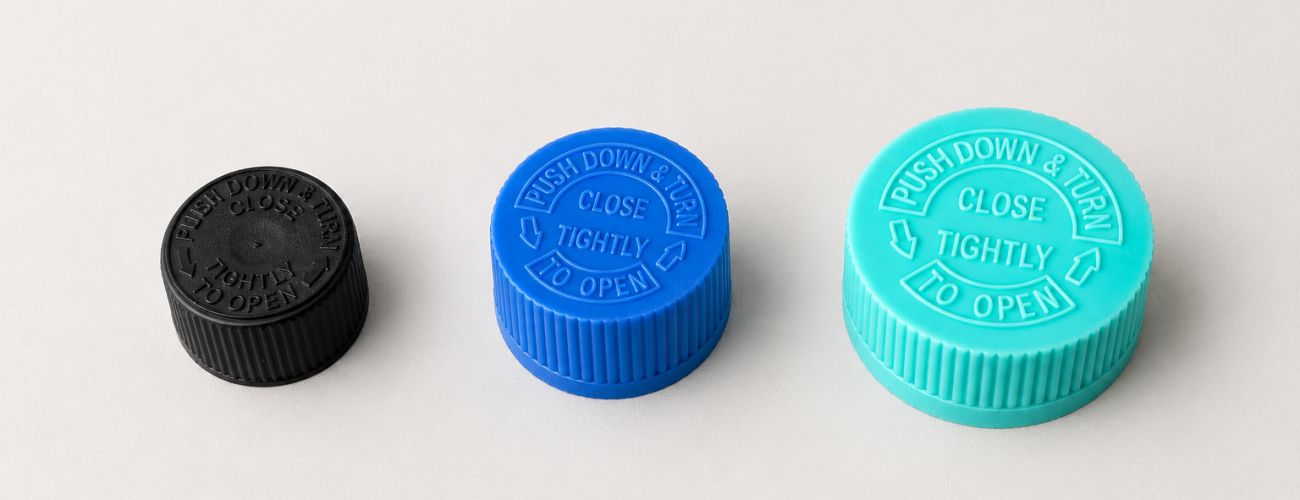
Left to right: 24mm, 28mm, and 38mm neck caps — the three most common standard sizes in personal care and food packaging. The physical size difference is significant and affects both bottle format and formula viscosity.
Quick-Reference Size Chart
The table below covers HB Packaging’s full stocked range. Use it as a first filter when sourcing or speccing a new closure.
| Neck Size |
Typical Bottle Format | Common Industries | Compatible Cap Types |
|---|---|---|---|
| 13–20mm | Dropper vials, nail polish bottles, small tubes | Beauty, pharmaceutical, nail care | Dropper, roll-on, snap cap, disc cap |
| 24mm | Travel-size squeeze bottles, narrow facial care | Personal care, travel retail | Flip top, disc top, lotion pump |
| 28mm | Standard PET/HDPE round and oval bottles | Hair care, food, household, pharmaceutical | Flip top, disc top, push pull, lotion pump, CRC, snap |
| 38mm | Wide-mouth squeeze, cosmetic jars, sports bottles | Hair care, personal care, food service | Flip top (wide), disc top, jar cover, push pull |
| 43mm | Large-format bottles, gallon containers | Professional, household, industrial | Lotion pump, disc top, screw cap |
| 52mm | Bulk dispensing jugs, wide cosmetic jars | Salon, professional care, household | Lotion pump (large), screw cap, jar lid |
Ready to browse? Filter HB Packaging’s full catalog by the neck size that matches your bottle.
How to Identify Your Existing Neck Size
If you’re sourcing caps for an existing product or bottle, you need to confirm the neck finish before requesting samples. There are three situations you might be in:
You have a physical bottle
Measure the outer diameter of the threaded section of the neck using digital calipers. Place the caliper jaws at the widest point of the thread — not the inner bore, and not the shoulder below the thread. A common mistake is measuring the inner opening, which gives a smaller and incorrect reading. Once you have the diameter, ask your supplier to confirm the full GPI thread code (e.g. 28-410) so thread pitch is also verified.
You have a spec sheet or technical drawing
Look for the notation labeled "neck finish" or "finish diameter" in the drawing callouts. This will show the full GPI code. If the drawing uses Imperial dimensions, your bottle supplier can cross-reference to the metric standard. Spec sheets from US bottle manufacturers typically call this out clearly in the product data sheet.
You're starting from scratch with a new bottle
Get the neck finish drawing from your bottle manufacturer before ordering any cap samples. It costs nothing to ask at the quoting stage and saves a full sample round if you've already narrowed down your closure direction. If you're designing the bottle and the cap together, choose your neck size based on cap availability first — the packaging ecosystem for 28mm is by far the most developed.
💡 Pro Tip
If you’re unsure of your bottle’s neck finish, you can send us your bottle spec sheet, a photo of the neck, or a physical sample. We’ll identify the GPI finish and recommend compatible caps from our range.
How Neck Size Affects Your Cap Options
Neck size isn’t just a dimensional spec — it directly determines which cap styles, materials, and functional mechanisms are available to you without custom work.
Standard sizes: widest selection, fastest timelines
For 24mm, 28mm, and 38mm necks, nearly every cap type HB Packaging produces is available in existing tooling. That means:
SHOP BY CLOSURE TYPE
View all products →
T series
Flip Top Caps
One-handed dispensing, available in multiple orifice sizes. Most common in 28mm and 24mm.
Q series
Disc Top Caps
Push-button dispensing, ideal for shampoos and body wash. Full range in 24mm and 28mm.
S series
Push Pull Caps
Pull-up-to-open mechanism for sports and outdoor use. Available in 28mm and 38mm.
HB series
Lotion Pumps
Metered dispensing for viscous formulas. Broad range from 24mm to 43mm.
C series
CRC (Child-Resistant) Caps
Compliant with safty. Available in 28mm; custom sizes possible.
V series
Silicone Caps
Flexible, food-grade silicone for unique bottle forms. Custom sizing available.
Sample lead time for standard sizes is typically 45 business days from order confirmation. Mass production lead times depend on quantity and finish options.
Non-standard sizes: fewer choices, longer lead times
If your bottle uses a finish outside the common ranges — say, a 32mm or 44mm neck — off-the-shelf tooling is unlikely to exist. You’ll either need to find a supplier who can adapt an existing mold cavity, or commission new tooling outright. This adds cost and lead time at the sampling stage. If you have flexibility on your bottle design, this is worth considering early.
Viscosity and neck diameter
Neck diameter also has a practical relationship with formula viscosity. Thicker products — body butters, heavy conditioners, pastes — need a wider orifice to dispense without excessive force or air pressure buildup. A 38mm neck gives the cap more room for a larger discharge orifice than a 24mm neck does, all else being equal. Your formulation team should weigh in here alongside your packaging supplier.
When Your Size Isn’t Standard: Custom Tooling
If your existing bottle uses a non-standard neck finish, or if your brand requires a proprietary cap that no existing mold can produce, custom tooling is the path forward. It’s more involved than sourcing off-the-shelf closures, but it’s also how brands build cap designs that can’t be directly replicated by competitors.
Modifying an existing mold
When your non-standard size is close to a standard size, a mold modification may be possible — removing or adding steel to adjust the cavity dimensions. This is lower cost than building a full new mold, but it’s only viable within a limited tolerance range and depends on the original tooling’s design. Your supplier needs to review the existing mold before quoting this route.
New mold tooling
A full custom mold gives you complete control over dimensions, wall thickness, hinge design, and orifice geometry. HB Packaging manufactures molds in-house, which means shorter tooling lead times and the ability to iterate on samples without involving a third-party toolmaker. Tooling cost depends on mold complexity and steel grade; single-cavity molds for standard cap profiles start at a lower price point than multi-cavity production tools.
For brands sourcing from China for the first time, briefing a supplier on a custom mold requires specific documentation — dimensional drawings, material callouts, and tolerance specs at minimum. If you’re unsure how to prepare a mold brief, our sourcing guide covers what to include.
Not sure what size your bottle is?
Send us your bottle spec sheet, a technical drawing, or a photo of the neck. We’ll confirm the GPI finish code and recommend compatible caps from our stocked range. If you need something custom, we can quote tooling directly.