
Refillable Beauty Packaging: 6 Proven Closure Specs

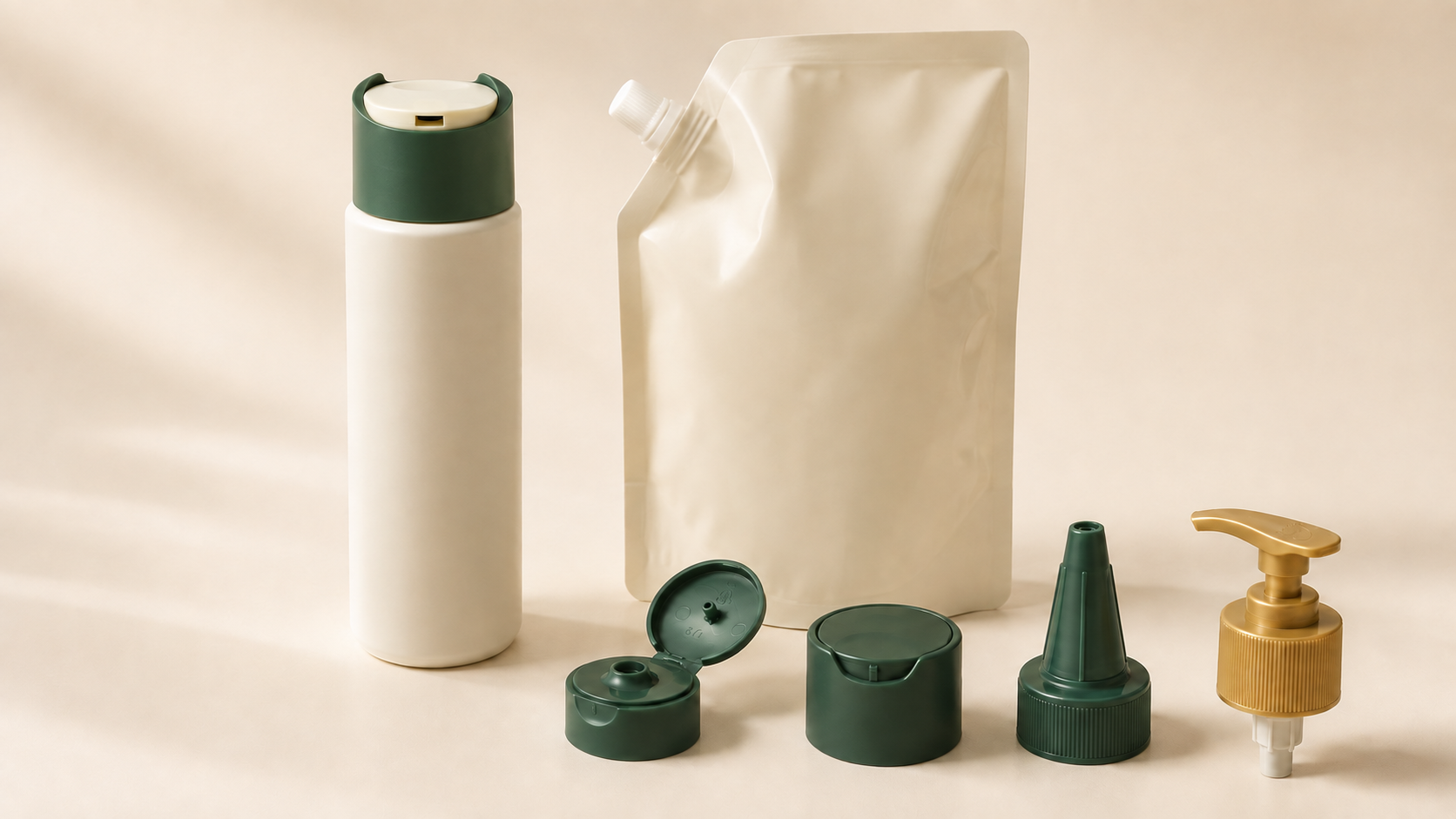
Refillable beauty packaging is a strong sustainability story, but the customer does not judge it by the claim on the label. They judge it in the bathroom, at the sink, in the shower, or while trying to pour a refill pouch into a bottle without wasting product.
Two different problems can turn that environmental idea into a poor repeat-purchase experience. During transfer, the refill pouch spout and bottle opening determine whether the product pours cleanly. After refilling, the cap or pump controls sealing, dispensing, residue, and everyday usability.
This guide separates those two stages, then explains how to specify caps, pumps, and dispensing closures for refill systems in skincare, haircare, body care, hand soap, and personal care.
Why Refillable Beauty Packaging Is Trending Now
Refill is not new, but the reason it matters in 2026 is sharper. Consumers still want sustainable packaging, but they are less willing to accept awkward formats just because the idea sounds responsible. Refill systems now have to be convenient, affordable, clean, and visually credible.
Amcor’s 2026 research across six European countries found that 66% of surveyed consumers had purchased a personal care refill pouch in the previous 12 months. The same study reported that 81% were more likely to buy refill pouches if they were recyclable, while 74% were more likely to purchase refills packaged in recycled plastic.
That creates an opportunity in shower and bath products, haircare, handwash, body lotion, and routine-use skincare. These are categories where consumers finish products regularly and can understand the value of keeping a durable bottle while buying lower-material refill packs.
But Western buyers should also look at the adoption barriers. Mintel’s 2026 beauty packaging outlook notes that refillable formats in the US grew only 7% in launches between 2022 and 2024, and that almost 70% of US consumers say in-store refilling is inconvenient. The message is clear: consumers may like refill as a concept, but they do not want extra work.
That is why at-home refillable beauty packaging is getting more attention. A pouch, bottle, and closure system lets the customer refill at home without finding a store station. For beauty refill packaging to work, the process has to feel controlled, hygienic, and worth repeating.
"Convenience must not be compromised."
Amcor, summarizing consumer expectations for personal care refill packaging in its June 2026 research. Read the Amcor release.
Where Refill Systems Fail: Transfer vs. Closure Performance
Many refill projects start with the pouch because it carries the visible sustainability claim. The pouch may use less plastic than another rigid bottle and can ship efficiently, but the consumer experiences two separate packaging interfaces.
First comes the transfer interface. The pouch spout has to align with the receiving bottle opening and deliver the formula at a manageable rate. A narrow bottle opening, wide pouch spout, unstable pouring angle, or fast-flowing formula can create spills and neck residue. An ordinary dispensing cap does not solve this stage because it is normally removed before refilling.
Second comes post-refill performance. Once the consumer replaces the cap or pump, the closure must fit the neck correctly, maintain its seal after repeated removal, dispense the intended dose, and manage residue during normal use. This is where closure selection and testing directly affect the experience.
Amcor’s research found that 35% of consumers reported perceived product waste from spills, and 29% named messiness during refilling as a key frustration. Those are not abstract sustainability concerns. They are direct packaging-performance problems.
For procurement teams, responsibilities should be clear. The brand and packaging partners should validate the pouch-spout-to-bottle-opening interface. The closure supplier should validate neck fit, torque, seal performance, dispensing behavior, open-close durability, and compatibility with the actual bottle and formula.
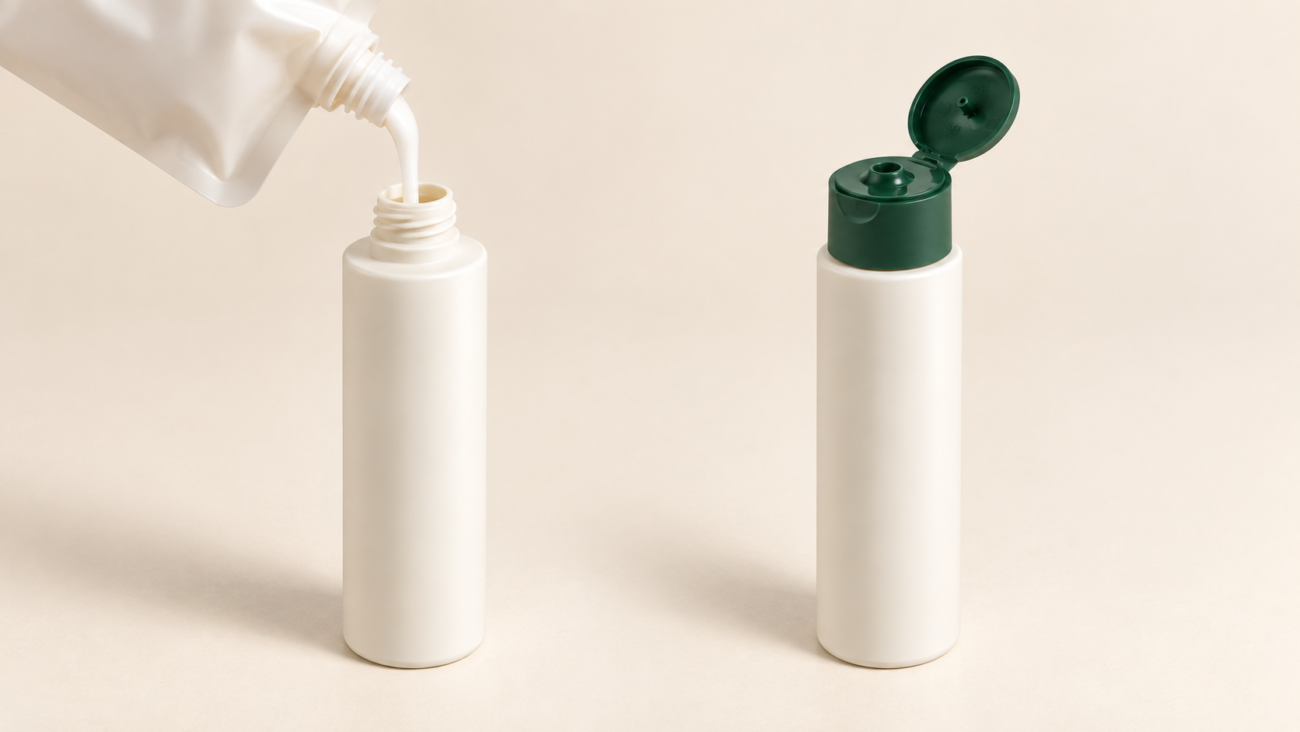
Left: the pouch spout and bottle opening control transfer.
Right: after refilling, the fitted closure controls sealing and dispensing.
Testing a refill concept? Send the bottle neck drawing, formula type, and refill method before sampling so the closure recommendation starts from the real system.
Refillable Beauty Packaging: 6 Fit and Closure Checks
Before approving refillable beauty packaging for production, confirm these six system and closure checks. Together, they cover clean transfer, secure reassembly, controlled dispensing, and repeated use.
1. Neck finish compatibility
Start with the full neck finish, not just the diameter. A bottle may be described as 24mm, 28mm, or 38mm, but the thread finish still determines whether the closure fits and seals. A 24/410 cap is not automatically interchangeable with every 24mm bottle.
This matters even more in refillable cosmetic packaging because the consumer may remove and replace the closure repeatedly. If the thread fit is weak, repeated opening can damage the seal or cross-thread the cap. Ask the bottle supplier for a neck drawing before sampling.
2. Leak testing and seal design
Refill products often travel through e-commerce, retail replenishment, subscription shipments, and bathroom storage. The closure has to survive upright, sideways, and inverted conditions. For liquid soap, shampoo, conditioner, body wash, and lotion, leakage can create both product loss and brand trust issues.
Test with the actual formula whenever possible. If the formula is not ready, use a close viscosity simulant and repeat the test later. Ask about plug seals, liners, thread engagement, torque range, and open-close cycles.
3. Dispensing control
Not every refill product needs the same cap. A shower gel may work well with a flip-top cap because the hinged lid supports one-handed use in the shower. A thicker lotion or conditioner may need a disc-top cap or pump for more controlled dispensing. A scalp oil or treatment refill may need a precision nozzle cap to avoid over-application.
The goal is to match formula viscosity, application context, and consumer expectation. Good refillable beauty packaging should feel familiar once the product is back in the reusable bottle.
4. Refill interface: bottle opening and pouch spout
The dispensing closure is normally removed before refilling, so it does not control the pour. Transfer performance depends on the exposed bottle opening, pouch spout diameter and length, formula viscosity, and pouring angle.
Brands should test refill behavior with ordinary users, not only packaging staff. Watch whether they can remove the closure, align the spout, pour at a controlled rate, replace the closure without cross-threading, and clean any residue. If transfer is unreliable, consider a wider bottle opening, narrower anti-drip pouch spout, funnel, or refill adapter.
5. Hygiene and residue control
Hygiene is one of the biggest barriers to repeat use. Mintel notes that hygiene concerns limit mainstream refill adoption, particularly when consumers worry about reusing packaging or unclear cleaning practices. In beauty, the concern is stronger for facial care, body care, baby care, and any formula used close to sensitive skin.
Closure choice influences hygiene after refilling, but no cap or pump guarantees hygiene by itself. Smooth external surfaces may be easier to wipe, while pumps can reduce direct hand contact during dispensing. However, pump channels, disc-top recesses, and nozzle tips can all retain product. Test residue buildup, cleaning access, drying, and closure performance over the intended number of refill cycles.
6. Material and PCR options
Refill systems are usually introduced for sustainability reasons, so the closure specification should support the claim. Ask whether the cap is PP, PE, PP+PE, or another construction. Confirm whether PCR material is available, whether color matching changes PCR options, and whether a mono-material closure is possible for the complete bottle-and-cap system.
McKinsey’s 2025 US consumer research found that price, quality, and convenience rank above environmental impact in purchase decisions. Refillable beauty packaging still has to perform like normal packaging while using less material or enabling reuse.
35%
Consumers reporting perceived waste from spills in Amcor’s refill research.
29%
Consumers naming messiness during refilling as a key frustration.
70%
Approximate share of US consumers who find in-store refilling inconvenient, according to Mintel.
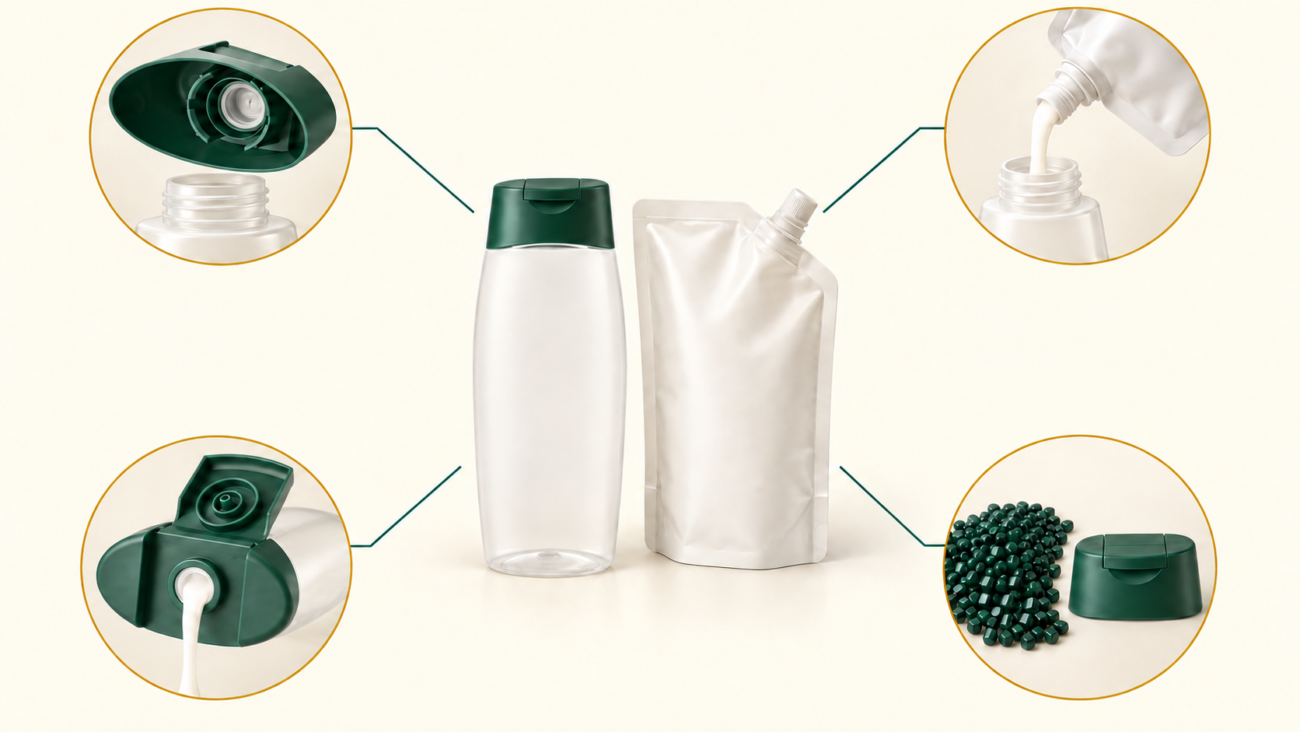
Refillable Beauty Packaging Closure Comparison Table
The table below is a practical first filter for sampling. It should be adjusted after formula testing, but it helps buyers decide which closure family belongs in the first round.
| Product Type | Refill Format | Recommended Closure | Key Risk | What to Test |
|---|---|---|---|---|
| Shampoo | Pouch to reusable bottle | Flip-top cap or pump | Transfer mismatch; post-refill shower leakage | Pouch spout/opening fit; cap seal; one-handed use |
| Conditioner | Pouch to bottle | Disc-top cap or pump | Slow transfer; dispensing blockage after refill | Transfer rate, flow rate, pump return, residue buildup |
| Hand soap | Refill bottle or pouch | Lotion pump | Pump wear or mismatch after repeated removal | Neck finish, dip tube length, pump output, reuse cycles |
| Body wash | Pouch to shower bottle | Flip-top cap | Inverted leaking in wet areas | Open-close cycle, inverted leak test |
| Scalp treatment | Small refill bottle | Nozzle cap | Over-application and tip residue after refill | Orifice size, formula stream, tip residue |
| Lotion | Reusable rigid bottle | Pump or disc-top cap | Actuator residue and cleaning after multiple refills | Drip control, cleaning access, torque retention |
Transfer tests evaluate the refill pouch and bottle opening. Closure tests evaluate sealing, dispensing, and performance after refilling.
How Brands Should Brief a Closure Supplier
A good refill brief should be specific. The more information a supplier receives at the start, the fewer sample rounds the buyer needs later. Include both the original pack and the refill method.
- Product type and target category, such as shampoo, body wash, facial cleanser, hand soap, lotion, or scalp treatment.
- Formula viscosity, fragrance load, oil content, actives, and any compatibility concerns.
- Bottle material, fill volume, shape, wall thickness, and complete neck finish drawing.
- Refill method, such as pouch-to-bottle, refill bottle, cartridge, salon backbar, or subscription refill.
- Target market, sales channel, shipping method, and expected storage position.
- Desired closure type, color reference, PCR requirement, mono-material goal, MOQ, and launch timeline.
For US buyers sourcing from overseas, documentation is also part of the brief. Ask for material declarations, available test reports, production lead time, sample lead time, and QC process information. HB Packaging is ISO 9001 and ISO 14001 certified, which supports quality consistency and environmental management documentation during supplier qualification.
If the product is still in development, tell your closure supplier which requirements are fixed and which are flexible. For example, the bottle shape may already be chosen, but the orifice size, cap color, and cap material may still be open. That helps the supplier recommend existing tooling before moving into custom mold work.
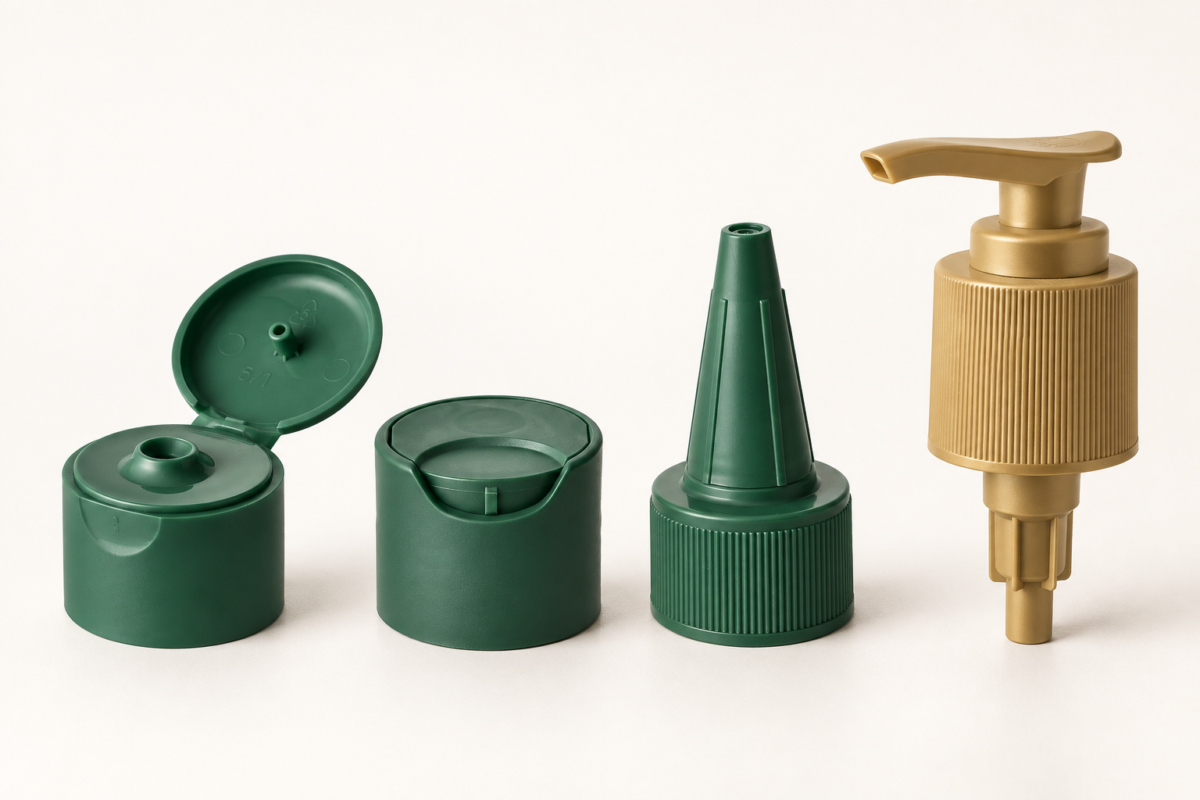
Best HB Packaging Closure Options for Refill Systems
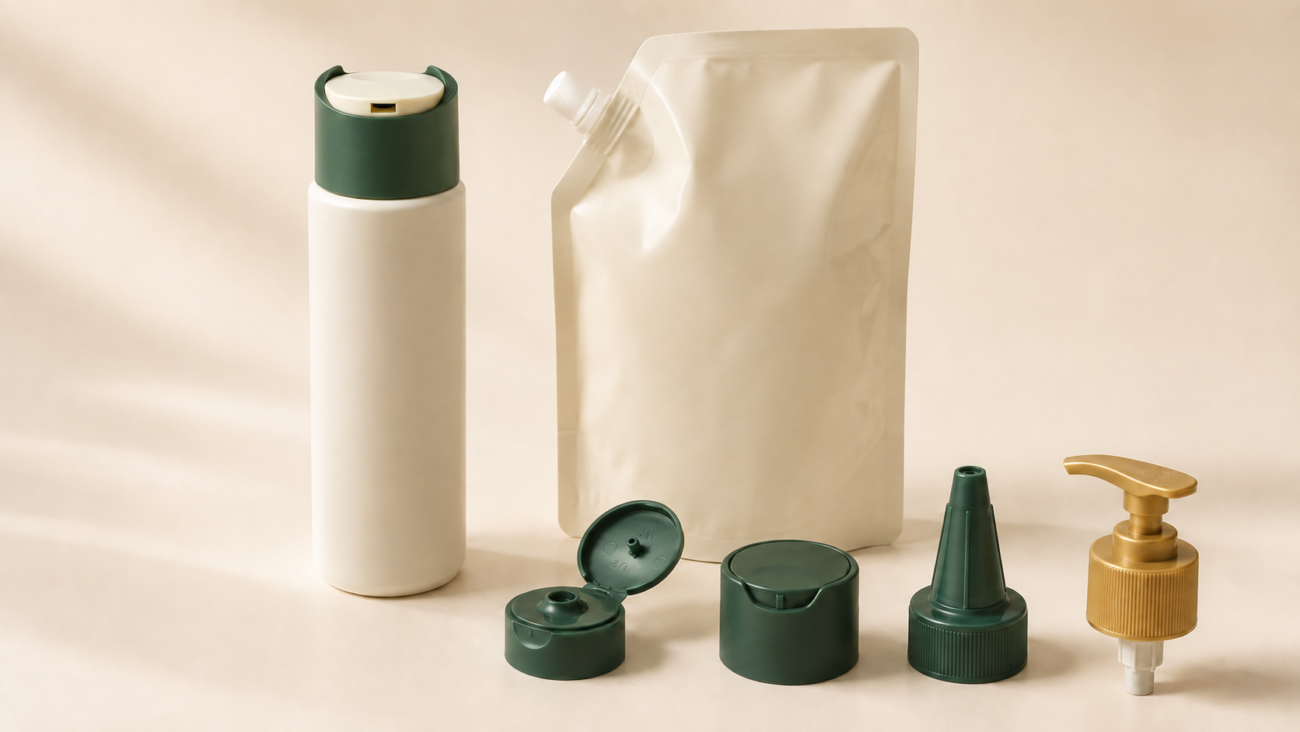
HB Packaging manufactures caps, closures, and pumps for haircare, skincare, personal care, food, and household applications. For refill systems, start with closure families that already match common bottle neck sizes and consumer habits.
Flip-top caps are the most practical choice for shower products, shampoo, conditioner, and body wash. They are familiar, cost-effective, and easy to use with wet hands. HB’s flip-top range includes multiple neck sizes and PP material options for hair care and personal care projects.
Disc-top caps are a strong fit when the brand wants a cleaner, more premium surface. They work well for lotions, creams, conditioners, and vanity-shelf products where the closure should look controlled and minimal.
Nozzle caps help when the finished product requires more precise placement after refilling. They are useful for scalp treatments, oils, hair color, and targeted care products where too much flow creates mess or product waste.
For refill systems that need a proprietary cap, special dispensing tip, or removable closure designed around a wider bottle neck, HB Packaging can support custom molding. In-house mold development helps buyers move from concept to sample with fewer handoffs between design, tooling, and production.
Conclusion: Refill Success Depends on the Complete System
Refill is a real growth opportunity for beauty and personal care brands, but it succeeds only when the experience feels easy enough to repeat. The consumer needs clean transfer into the reusable bottle, followed by reliable sealing, dispensing, storage, and cleaning.
Specify the cap, pump, or dispensing closure early, but do not ask it to solve the transfer stage alone. Confirm the pouch spout and bottle opening first, then test neck finish, seal design, dispensing control, hygiene performance, durability, and material options with the real formula and actual pack components.
When refillable beauty packaging works well, the pouch spout helps the product enter cleanly and the closure takes over after refilling. It keeps the package sealed, controls how the formula is dispensed, and supports a routine the consumer is willing to repeat.
Request Closure Samples for Refillable Beauty Packaging
HB Packaging can help you compare flip-top caps, disc-top caps, nozzle caps, and custom closure options for refillable personal care systems.
Send us your bottle drawing, formula type, refill method, target neck finish, preferred color, and expected reuse cycles. Our team can recommend closure samples and the tests needed before production.
Catch the packaging decisions your competitors are already making.
One practical brief each month on closure specs, compliance shifts and sourcing mistakes, before they turn into samples you have to redo.